
Keeping Watch
Fiction/ Short Story
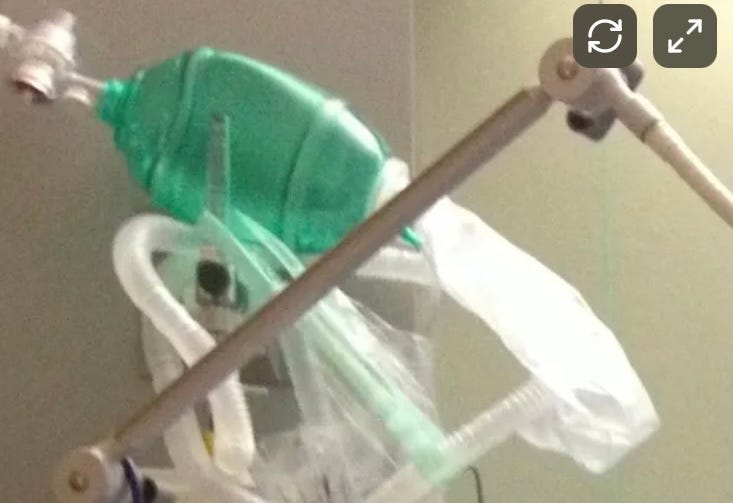
(Photograph by Author)
I reached the hospital after the rush hour traffic had died away, feeling guilty for arriving late.
My mother had been in the ICU for the past three days. Following the first day, when the situation was still unfamiliar, I had fallen into the pattern of alternating shifts with my sister; she sat with my mother during the day, and I came over to the hospital after work. My sister Anisha had set the pattern. “If you want to help me,” she had said, “you can get here by six-thirty, so I can get home to the kids.” I understood her implication, but I ignored it, not having the energy to address her thoughts about me.
“What did the doctor say?” I asked my sister on this evening.
“He says at this point it’s a waiting game.” The doctor had said the same thing to me, when I met him the first morning.
“Is there anything I should know?”
“No, everything’s been done. The nurse administered the evening meds, so things are set for the next four hours. Just text me if something changes.”
After my sister left, I settled into my usual chair, setting down my cup of coffee, and bowl of tomato soup from the cafeteria. My mother would have protested at the sight of my evening meal. It’s better than what you’re having, I thought, slipping into the internal dialogue I maintained with my mother on these nights.
The staff had encouraged me to talk to my mother, suggesting she might be able to hear my voice, even though she appeared unresponsive. I wasn’t sure if I believed them. In any case, it didn’t feel natural to keep up a one-sided monologue with my mother out loud. I preferred to think she couldn’t hear what was happening, not in the external sense.
The first few nights, my mother’s friends had come by, bringing food, which I had placed in the staff fridge, and Anisha had taken away the next day. Thankfully, I was alone this evening.
The background sounds, the various beeps and signals, had grown familiar, over three nights. I recognized the aide who came to check vital signs. About ten o’clock, a woman entered the room, whom I hadn’t met before. She greeted me with a soft smile, telling me she stopped by to visit the patients like my mother. She stood quietly for a few minutes, with her eyes closed, then unobtrusively left the room. It seemed like a sensible way to visit a patient in the ICU, better than arriving with food and conversation.
I was starting to drift off, reclining in the chair, when I was roused by a sound nearby: the alarm at my mother’s bedside was making a harsh, insistent clamor, demanding immediate attention. Medical staff hurried to the cubicle. and I was ordered to wait outside.
I thought about calling Anisha, but decided against it, not wanting to face questions which had no answers. It wouldn’t help anyone if she rushed over at that hour. I would let her know, once I had something to tell.
I took a walk around the eighth floor, giving myself five minutes; by the time I returned, the staff had stabilized my mother’s condition. For some unknown reason, her blood pressure had dropped sharply, and the doctors added a new medication to the current mix. I considered, for a brief moment, whether my mother might have wanted to slip away at this juncture, but pushed away the thought.
Oddly, the room felt more peaceful than it had before the recent crisis. I wondered whether crises involving life and death changed the atmosphere of a place. Looking out through the open curtain, I saw the woman who had visited earlier, emerging from the room across the hall. I hadn’t noticed the patient in that cubicle having visitors, up to that point. The woman was clearly dedicated to her mission, being at the hospital after midnight. Upon stepping out, she met my eyes, and nodded slightly in recognition.
Later, during the night, I heard the warning alarm, across the hall, indicating a patient in distress, and the sounds of people hurrying to help.
The next morning, Anisha was predictably angry, because I hadn’t texted her, and further irritated that I couldn’t remember the name of the new medication. I suggested that she talk to the doctor during morning rounds, and escaped to the office.
At work, I had a long talk with my co-worker, whose father-in-law had spent time in the ICU. I ordered a large lunch, sandwich and soup, and saved half to take back to the hospital, arriving in a much better frame of mind than the previous evening.
The first part of the night passed uneventfully; staff came to check my mother’s vital signs, they checked her breathing, and took blood samples. I noticed the room opposite my mother’s cubicle now stood empty. The patient had either improved, and transferred to another room, or the person hadn’t survived. The emptiness of the space, and the alarm I had heard, inclined me towards the latter outcome.
The woman from the previous night stopped by my mother’s cubicle, around the same time as before. “Have you been here long?” I asked, not knowing her exact position.
“Yes,” she said, quietly, but didn’t elaborate. I watched her, as she stood with eyes closed, and this time I felt the atmosphere in the room shift. The chill lingered, after the woman left the cubicle, and I asked a nurse about the drop in temperature. She offered to bring me another blanket, telling me people often found the hospital cold. I had grown accustomed to the climate in the ICU, it didn’t explain what I felt.
The next time a nurse came by, I asked about the woman visitor. “Do you mean the social worker?” the nurse replied. “She comes by at different times, but I think she was out today.”
It was possible I needed something to divert my mind from the current situation. Rather than focus my thoughts on my parent, lying on the bed, I kept my eye out for the unknown woman. My train of thought was interrupted, when my mother’s alarm began to sound, the same insistent clamor as the night before.
Without being told, I knew the crisis was more acute this time. I stayed in the waiting room, flicking through photographs on my phone, not seeing them. After a while, the doctor came to tell me, my mother’s condition had stabilized, though this time it had taken a hefty injection of medication directly into a vein. When I asked why my mother had crashed at the same time on two successive nights, the doctor replied, it was impossible to tell. With a patient in the ICU, I should expect fluctuations. His assessment was correct, but the explanation struck me as incomplete.
As the doctor stepped away, the hospital chaplain came forward to greet me. My mother’s condition had been precarious enough that someone had summoned the chaplain. I told him I didn’t need anything just then, but thanked him for the visit. I mentioned that a woman had stopped by my mother’s cubicle on two occasions, to pray. Perhaps she belonged to his staff?
The chaplain said, he would be happy to pray with me, but he had no staff or volunteers who worked in the ICU, other than himself.
Recalling my thoughts to the present, I texted Anisha, giving her the update. I asked her to bring me a cup of coffee on her way to the hospital.
As I waited in the hall, I caught sight of the unknown woman, leaving the cubicle at the far end of the passage. By the time I reached the place, she had disappeared around the corner. I didn’t mention the woman to my sister when she arrived. What could I say? It would be difficult to explain to Anisha, I’ve encountered a woman who seems to suck the energy from patients’ rooms. I think our mother is in danger - in the ICU - where she’s being monitored at all times, because she’s in critical condition. Anisha would tell me to focus on the necessities of the moment. I sat beside my mother’s bedside, while Anisha talked to the medical staff. We spent the rest of the night discussing our mother’s health, staring at the monitor screens, hoping she couldn’t hear us talking about the numbers. I wasn’t surprised to hear the alarm, indicating a crisis, down at the end of the passage, before sunrise.
I took the morning off from work, and thought hard about the things I had seen at the hospital. It appeared that nobody noticed the woman’s activities, besides myself. I doubted that anyone would believe me if I told them, a woman was absorbing the life force from patients in the ICU. It was possible she only visited patients who had reached the end of their time. I pushed away the implications of this supposition for my mother. I had no way to predict what might happen to my mother, and no way to ascertain who the woman might be. It didn’t matter. I understood what I had to do.
I drove directly to the hospital, without stopping at the office, surprising Anisha by arriving early. I told my sister, I would like to speak to her before she left. I had brought her favorite latte. Handing it over, I found my usual seat. Sitting in the dim light beside my mother’s bed, I told Anisha, I had observed a woman, not a member of the medical staff, entering the patients’ cubicles. I didn’t have to say anything else. Anisha is nothing if not careful about our mother’s safety. She informed the hospital staff about my observation; they took note, but didn’t recall seeing anyone fitting that description, and nothing showed up on the hospital cameras. I had expected the staff to follow protocol. My sister prefers to take precautions, whenever possible. I can trust her to be vigilant when necessary. Anisha will help me keep watch.
It brings me up to the present moment. I don’t know whether my mother will survive this episode. I don’t know how long the life force will remain in her body. But, I will watch over her to make sure no outside entity interferes. It’s the last thing I can do for my mother, and I don’t intend to leave her alone.
My newsletter is a mix of short fiction (speculative and slice of life), creative non-fiction, and occasional poetry. If you’re interested, I hope you will subscribe. Thank you for reading!
.
Great writing as always. I know those beeps and plastic covered chairs. Well evoked.
This was so well-written! I’m headed to your archives.
Wishing healing and solace for you and your family <3333