
Penning A Sampler
Personal Reflection

My brother was diagnosed with cancer last year. He has gone through brain surgery, chemo, and a bone marrow transplant, with remarkable success (touch wood). He has spent very little time confined to bed, given the procedures he has undergone, though sometimes he doesn’t feel up for long conversations, even when he appears to be awake and doing typical things.
During the past year, I have had occasion to visit my brother, more often than I might usually do. We have fallen into the habit of watching “Antiques Roadshow,” when I’m over in the evening. It’s a good program to watch if you don’t feel up to following a fictional plot, ot don’t want the stress of a competition show.
If you haven’t seen “Antiques Roadshow,” it’s a program where people bring in items from home - antiques, family heirlooms, things they picked up - and have them publicly appraised, You get to hear a little about the history of the item and the owner’s story, then the appraiser tells you how much the item might be worth in monetary terms.
From episode to episode, you see people bringing in similar things, though always presenting a personal twist.
Over time, I’ve seen a few people bring in samplers, sewn by a girl from their own family back in the past, or picked up as a collectible.
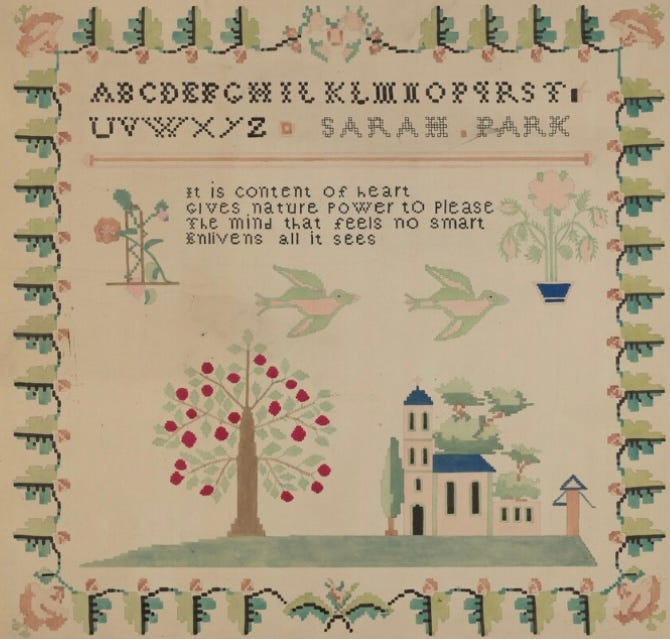
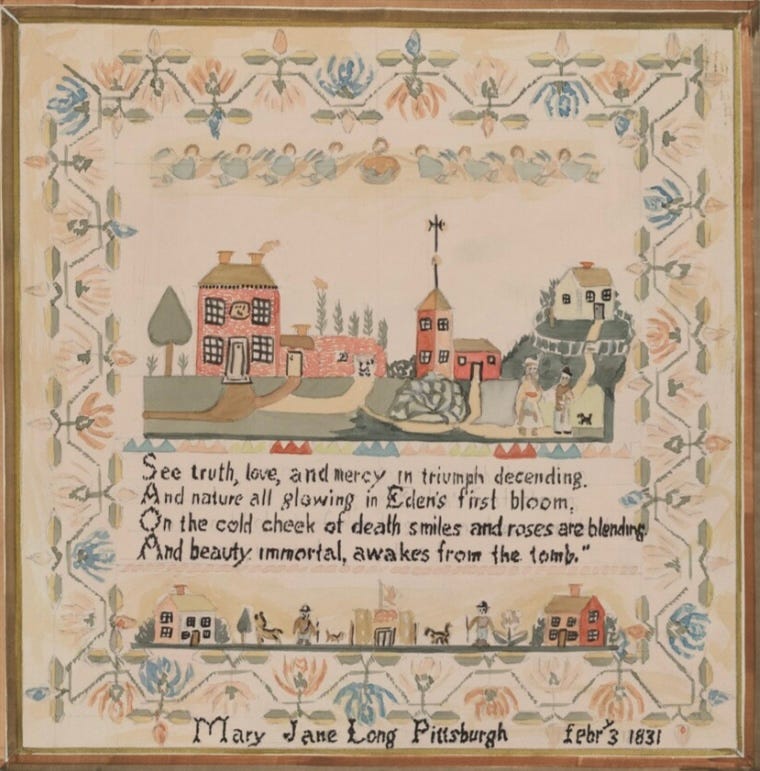
A sampler is a complex piece of sewing, done over time. It features different kinds of stitches, forming a set of images and words; it often includes a proverb or a motto; it might mention the name of the creator, as well as the place and date it was completed; and invariably it is presented in a frame. The sampler represents practice and exemplifies the creator’s skill.
It has occurred to me that writing on Substack is analogous in many ways to creating a sampler.
If we look beyond the metrics that depend on other people’s response (clicks/ views/ likes/ subscriptions), what you will have at the end of your time writing on Substack will be the collection of your newsletters. You won’t have a single piece of work, you will have the compilation of your writing, the sampler made up of all your posts.
While I am not yet convinced that it’s necessary to have a specific niche on Substack (outside of self-help) I have noticed that most writers have a frame. It might be their genre, or a specific life experience that colors their writing, or a recognizable style. My frame on this site will likely be influenced by the length I have chosen (short pieces) as well as my voice, even when the subjects vary.
If you read through a number of posts written by the same writer on Substack, you can usually get a sense of the theme or motto they are expressing. It recalls the motto attached to many samplers.
I’ve come across writers on Substack who present a variety of forms - prose, poetry, essays. Their writing reminds me of a sampler that includes a mixture of words, verses, and figures. When I come across someone who is focused on writing long-form serial fiction or releasing a novel by chapters, it reminds me of the sampler that presents a composed image.
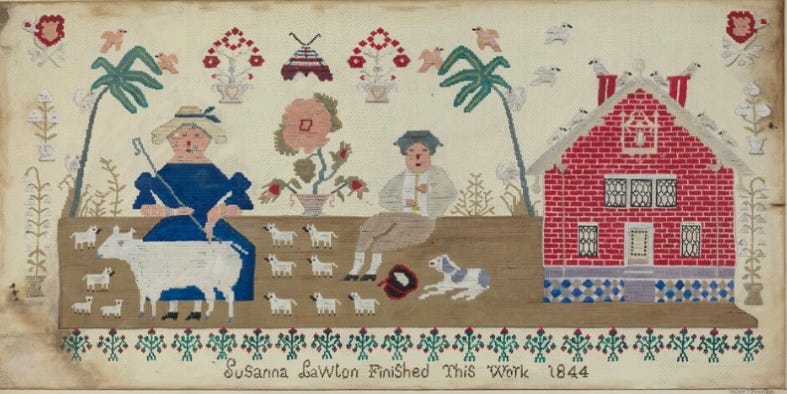
I’ve found it helpful to think about writing on Substack in terms of penning a sampler, because it gives me a visual for the work itself, existing as the sum of its parts, apart from the readers’ (or the algorithm’s) response to each individual piece.
By engaging in the exercise, creators can improve their skill, identify the kinds of work they enjoy most, and consider their presentation.
When I look around at different publications, I see a variety of samplers, some intent on showcasing different forms, while others focus on presenting a composed picture.
I am reminded that part of the fun of being around writing-in-progress is the opportunity to see the work unfold, rather than being offered the finished product, the completed sampler.
Happy stitching.
Until next time.
[I wrote a post about my brother in November 2025, a few months after publishing the preceding post - here’s the link - Thankful For Turtles].
My newsletter is a mix of short fiction (speculative and slice of life), creative non-fiction, and occasional poetry. If you’re interested, I hope you will subscribe. Thank you for reading!
Beautiful analogy!
Thank you!